

By :
|

Experienced mariners know how routing around the Cape of Good Hope has been viewed as an exception rather than a plan. It was the alternative considered when circumstances made the Suez Canal temporarily unavailable. Commercial schedules were not originally built around the route.
Recent developments changed the strategies.
What started as a response to geopolitical disruption in the Middle East is now a part of voyage plans for Asia-Europe and Gulf-to-Asia trades at least till 2027.
Crews are spending a longer time at sea. What’s more, every additional day at sea affects fuel consumption, emissions exposure, schedule reliability, and voyage economics. When routes lengthen and operating costs rise, vessel efficiency – that is, usually a performance metric - becomes a determining factor in commercial competitiveness.
A Price Tag for Every Sailing Day
Depending on their size, speed, operating profile, and weather conditions, daily fuel consumption varies widely across the fleet: a Suezmax tanker burns in the region of 55–60 tonnes a day, and many mid-size bulk carriers and container vessels fall within a comparable 50–80 tonne band, while the largest boxships run considerably higher. When voyage duration extends beyond what was decided in the original plan, the maths is difficult to ignore. A vessel otherwise consuming 60 tonnes of fuel a day will burn 600 more tonnes if it sails for ten extra days before reaching its destination.
These fuel burn rates don’t merely reflect on the bunker invoice. Higher fuel consumption translates into bigger emissions exposure, places pressure on voyage budgets, and can also affect schedule reliability across subsequent port calls. For vessels operating under tight commercial commitments, extended transit times impact asset utilisation and revenue generation.
Another reason it matters is that long voyages amplify every inefficiency onboard. Any performance loss that could go unnoticed on a shorter passage gets thousands of added nautical miles over which to accumulate. The rise in voyage duration makes fuel burn a commercial concern.
Why Traditional Performance Management Does Not Work for Longer Detours
Longer voyages place vessel operating characteristics under more scrutiny. The common contributors to performance drift include:
Considered in isolation, none of these factors may seem significant. But their cumulative impact is significant when a vessel spends several additional weeks at sea.
That brings us to a practical question: how do we catch these changes before they actually inflate voyage costs?
Keeping Efficiency on Course
Even if longer voyages do not introduce new performance-drift challenges, they make existing ones more prominent and more expensive. With live vessel visibility, operators can curtail them to improve commercial outcomes.
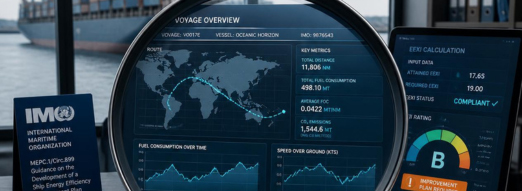
For example, real-time shaft power monitoring helps operators identify increases in propulsion demand before they affect fuel consumption trends. Instead of catching and working on a performance issue at voyage completion, corrective action can be taken while the vessel is still underway.
Main engine load tracking provides a clearer understanding of how the vessel operates across varying conditions. This helps distinguish between fuel consumption driven by external factors and consumption linked to the vessel's own performance.
With speed-power curve analysis, crews can compare expected and actual vessel behaviour. Deviations are easier to identify, supporting informed decisions on speed management and voyage planning.
High-frequency data from a ship also helps with trim optimisation to keep operations optimum as weather, draft, and voyage conditions evolve. Even minor adjustments can lead to significant fuel savings when sustained over thousands of nautical miles.
The goal of making corrections on the basis of live data is not to reach perfect levels of vessel operation because no voyage can be undertaken under “perfect” conditions. But high-frequency information has value because it helps avoid fuel burn and recognises performance losses before they accumulate over an extended journey.
Now that Cape diversions are part of routine planning rather than occasional disruptions, the economics of vessel monitoring will look meaningful.
Preparing for a Different Cost Landscape
We don’t know whether vessels will continue routing around the Cape of Good Hope for just another year or longer, but operators are preparing for an environment in which they can no longer afford to measure voyage distances, operating costs, and fuel budgets by historical norms. Under the conditions they face today, even slight improvements in vessel performance based on real-time data can yield major financial benefits across a fleet.
Periodic optimisation has given way to continuous operational awareness. Knowing exactly how the vessel behaves during a voyage allows efficiency losses to be addressed before they are reflected in the final fuel bill.
The question that ship operators face today is straightforward:
If vessels are burning 20–35% more fuel per voyage than they did a few years ago, the real question isn't the extra distance: it's how much of that fuel is being lost to inefficiencies you could still correct while the vessel is at sea.
















.png)




















Sign up to our monthly newsletter where we will share insights, invites to exclusive webinars and other events.


